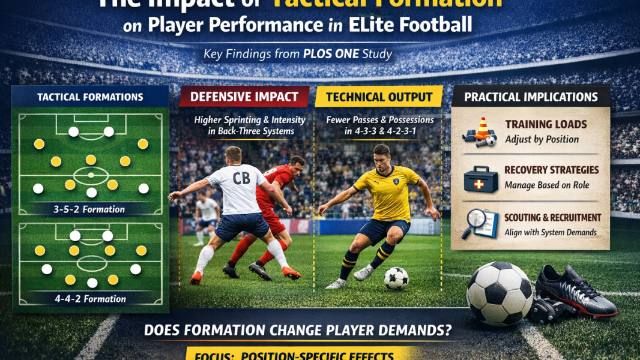
In modern football, tactical formations are often discussed in terms of structure, game model, and strategic identity. However, an important question remains for performance analysts and coaches: To what extent does formation influence the physical and technical demands placed on players? A study published in PLOS ONE (March 17, 2022) provides valuable evidence to address this question. Using official data from the German Bundesliga (2018–2019 season), the researchers analyzed 3,810 full-match player observations, focusing exclusively on players who completed the full 90 minutes.
Players were categorized into five key positional groups:
- Center backs
- Full-backs
- Central midfielders
- Wide midfielders
- Forwards
The study compared eight tactical formations, including 4-4-2, 4-2-3-1, 3-5-2, and 3-4-3, enabling a comprehensive evaluation of how systems influence performance outcomes.
Formation and Player Demands: A Position-Specific Effect
One of the most significant findings of the study is that the impact of formation is not universal across the team, but rather highly dependent on positional roles.
Defensive Units: The Most Affected
The study demonstrates that center-backs and full-backs experience the greatest physical impact when playing in back-three systems such as 3-5-2 and 3-4-3.
In these formations, players recorded:
- Higher sprint distances
- Increased high-intensity running actions
This can be explained by the tactical responsibilities associated with these systems. In a back three, defenders are required to:
- Cover wider horizontal spaces
- Engage more frequently in defensive transitions
- Support build-up play under pressure
As a result, the physical load on these players increases significantly compared to traditional back-four systems.
Midfielders and Forwards: Relative Stability
In contrast, central midfielders and forwards showed minimal variation in physical output across formations. This finding challenges a common assumption in football analysis — that changing formation automatically leads to major changes in workload for all players.
Instead, the data suggests that:
- Central roles are more stable in terms of physical demand
- Their performance is influenced more by game context than by formation alone
Technical Performance and Ball Involvement
Beyond physical output, the study also examined technical metrics such as passing and ball possession.
The results showed that:
- Most positions (excluding forwards) recorded fewer short passes, medium passes, and ball possessions in formations like 4-3-3 and 4-2-3-1
- This indicates a variation in team interaction patterns and ball circulation dynamics.
These findings highlight how formations can influence not only movement demands but also player involvement in possession phases.
Practical Implications for Coaches and Analysts
From a performance-analysis perspective, the study reinforces a critical concept: Formations redefine role demands rather than simply reorganizing team structures.
This has several practical applications:
1. Training Design
Training sessions should be adapted to reflect formation-specific demands, particularly for positions heavily affected (e.g., center backs and wide players in back-three systems).
2. Load Management & Recovery
Sports science and performance staff must consider positional load variations when planning recovery protocols, especially after matches played in physically demanding systems.
3. Recruitment & Player Profiling
Scouting and recruitment strategies should align with the physical and tactical requirements of the intended formation, ensuring players are suited to the system’s demands.
Conclusion
The study provides strong evidence that tactical formations such as 3-5-2 and 4-4-2 are not merely structural choices, but functional frameworks that directly influence player performance. Rather than asking which formation is “better,” practitioners should focus on a more relevant question: How does each formation reshape the physical and technical demands of specific positions? In elite football, success lies not only in selecting the right system, but in understanding how that system interacts with player roles, physical output, and tactical execution.