
As Liverpool continues to reshape their attacking options, the comparison between Hugo Ekitike and Alexander Isak presents two distinct yet complementary striker profiles. Ekitike offers raw athleticism, high-tempo verticality, and creative output that thrives in transitional moments. Isak, by contrast, brings a more polished, complete striker skill set—ideal for structured attacking phases. This article explores their strengths, tactical suitability, and potential impact within different team systems.
When comparing the profiles of Hugo Ekitike and Alexander Isak, each forward brings distinct strengths that suit different tactical demands. Ekitike stands out in areas that emphasize directness and intensity—offering more explosive output in front of goal, greater involvement in chance creation, and dynamic ball progression through carries. His style aligns with high-tempo, transition-focused systems. Conversely, Isak excels in areas requiring composure and refinement, showcasing superior finishing technique, reliable link-up play, and aerial strength. The following breakdown highlights where each striker holds an edge over the other across key performance metrics.
Ekitike has more advantages over Isak in:
- Goal threats: Generates a higher volume of—and higher‑quality—attempts per 90′. Profiles as a “volume shooter” who exploits space early and often.
- Chance creation: Contributes more directly to the final pass/shot. Fits well in a transition-play strategy that relies on quick combinations or cut‑backs.
- Ball progression: Comfortable driving at defenders; useful for beating the first press and attacking isolated full‑backs.
- Defensive work-rate: Shows greater activity when the press is beaten, hinting at higher counter‑press intensity.
However, Iska has more advantages over Ekitike in:
- Displays superior shot selection and composure in tight spaces: Exhibits more refined finishing mechanics and consistency inside the penalty area.
- Link-up reliability: he has a better pass completion %: Cleaner in short‑to‑medium combinations; lowers turnover risk around the D
- Aerial duels won: Provides a target for direct balls and adds set‑piece value.
- Defensive tasks: Blocks and Clearance: Contributes marginally more when defending deep rest‑defense situations.
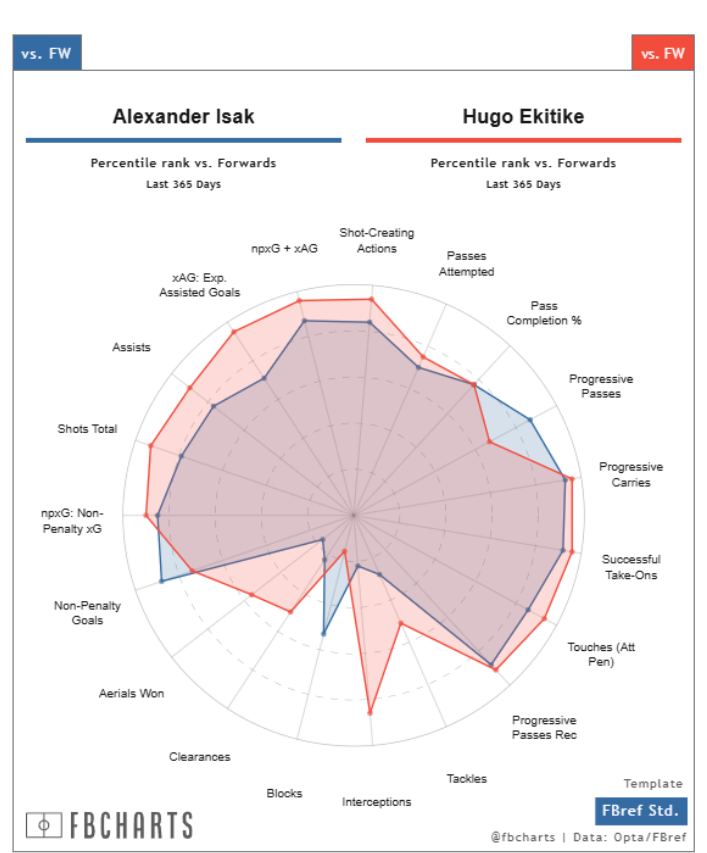
From these comparisons, Ekitike is a dynamic, high-tempo forward. Thrives in transitional or counter-attacking systems. Stronger in ball progression, chance creation, and carries—though less clinical in front of goal. He brings more raw energy, creativity, and 1v1 ability—suitable for pressing systems or teams relying on vertical transitions. Isak is ideal for teams needing a reliable finisher with intelligent positioning and composure in front of goal. A refined, efficient striker who operates well in structured, possession-based systems. Combines clinical finishing with strong movement and decent passing.
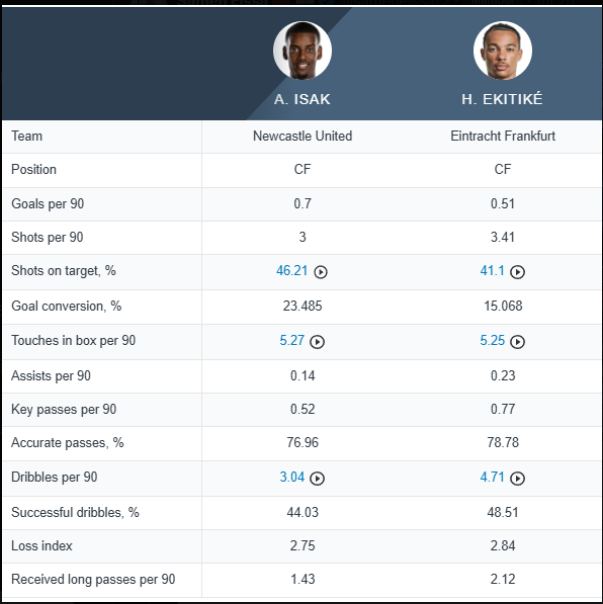
In summary, Ekitike and Isak represent two ends of the striker spectrum—explosive dynamism versus refined efficiency. Ekitike suits high-pressing, counter-attacking systems with his direct runs, dribbling ability, and creative threat. Isak, on the other hand, fits possession-oriented setups, offering clinical finishing, smart link-up play, and aerial presence. Used together, they could form a complementary duo—balancing chaos with control—and significantly bolster a squad like Liverpool’s with versatility and depth in the final third.
#FootballAnalytics #TacticalAnalysis #PremierLeague #ScoutingReport#Ekitike #Isak #LiverpoolFC #StrikerComparison #TransitionPlay