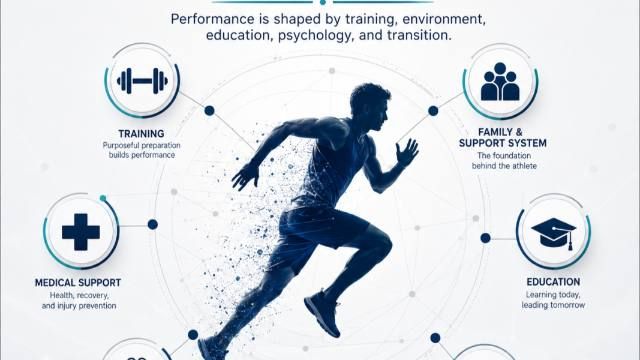
When we talk about elite athletes, we often focus on the visible side of performance: training loads, match performance, technical proficiency, tactical understanding, physical capacity, and results. However, based on the Barça Innovation Hub course “Certificate in Sport Psychology for Athletes’ Development,” this article reflects a deeper truth: an exceptional athlete is not merely a body that trains or a talent that performs. An athlete is a complete human system, shaped by sport, family, education, psychology, culture, environment, expectations, and life transitions.
One of the most powerful themes is the shift from the traditional style of training, where performance was typically divided into separate parts: physical, technical, tactical, psychological, and medical. This contrasts with the systems model, which states that we cannot understand the “whole” athlete by analyzing individual pieces in isolation. The athlete’s performance is a function of the interaction between all these pieces, not one item alone, that is particularly significant in modern football and high-performance sport. A player’s technical decision is never just technical. It is affected by confidence, fatigue, game context, coaching information, family pressure, academic stress, social relationships, and even future uncertainty. Consequently, the athlete’s instruction and training should be considered as a unified process that integrates biology, neuroscience, systems theory, information theory, and ecological thinking.

The ecological model adds another vital aspect. The athlete does not develop in a vacuum, as their environment includes family, coaches, tutors, medical personnel, club staff, teachers, psychologists, teammates, and broader social or cultural influences. Each of these layers can either support or limit the athlete’s development. Here, athlete welfare becomes not just an ethical responsibility but a concrete performance issue. I would argue that a sporting career is a journey through stages: beginning, development, refinement, and finally withdrawal or transition out of sport. Each stage has different requirements, risks, and support needs. The young athlete beginning high-performance sport faces very different challenges from the veteran player preparing for retirement, but both need direction, strategy, and emotional support.
The dual career is one of the most important aspects of an athlete's life. Many athletes have to combine sport with education, vocational training, or a future career. It is not simple to maintain this balance, yet it is necessary. Dual careers can allow athletes to form an identity beyond sport, reduce future-related anxiety, and develop transferable qualities such as discipline, teamwork, leadership, time management, and resilience. This means that support should not be exclusively athletic for clubs and institutions. It should also be financial, psychological, social, and academic. Support, therefore, should not be limited to training sessions, coaching, or performance analysis; however, athlete development needs a wider support structure that protects both performance and long-term personal growth. These support pillars can be academic, athletic, and financial, including flexible admission requirements, adjusted academic deadlines, personalized study schedules, tutoring, scholarships, professional support services, student grants, and lifestyle management support.
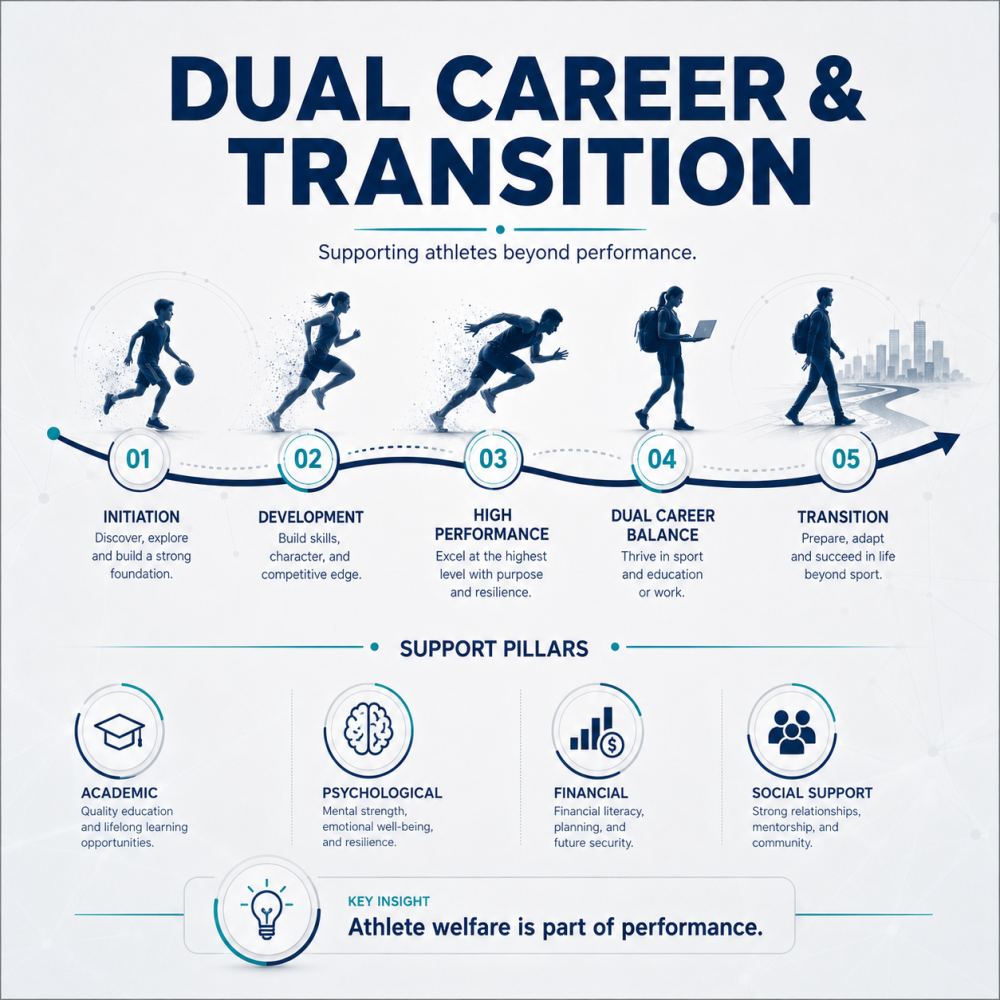
In practical terms, this means clubs and institutions should help athletes manage the conflict between training, competition, education, and future employment. A flexible academic schedule, for example, allows an athlete to continue studying without being forced to choose between exams and training. Tutoring gives the athlete individual guidance when travel, fatigue, or competition blocks normal learning. Scholarships and student grants reduce financial pressure, especially for athletes who cannot work alongside sport. Transition programs are also crucial because they prepare athletes for life after sport, rather than leaving them to face retirement or career change without direction. The main idea is simple: if we want athletes to perform at a high level, we must build systems that support their full life, not only their sporting output. A well-supported athlete is more likely to stay balanced, motivated, educated, and prepared for both success in sport and life beyond it.
A Case Study
For 14-year-old water polo player Mario, moving into a high-performance center with double training sessions, school commitments, and residence life was a difficult adjustment. The intervention focused on his daily routine, sleep, study time, social life, and adaptability to the new environment. The bottom line is that sometimes performance difficulties are not solved by more training but by better structure, recovery, communication, and time management.
Alba, an 18-year-old handball player, faced several transitions at the same time: from junior to adult sport, to university, back home after living in a training center, and adapting to a new role in a stronger squad. The intervention was based on a mobilization model: understand the athlete, identify difficulties, examine barriers and resources using SWOT analysis, select coping methods, develop a plan, and follow up. It is a great example of how psychological support can turn confusion into structure.
Esteban, a 15-year-old footballer with professional potential, was eager to leave education and concentrate purely on football. The intervention allowed him to explore expectations, vocational possibilities, and life beyond the desire to become professional. An important lesson in football academies: protecting the dream does not mean ignoring reality.
Laura, a 19-year-old skater, was affected by repeated injuries and eventually had to retire. Her case highlights the emotional difficulty of involuntary retirement but also the importance of guiding the athlete toward a new identity. Decision-making tools, narrative work, farewell rituals, and a new coaching-related role helped transform her sporting experience into academic and professional development.
The major takeaway for me is clear: Performance is not just what happens on the pitch, court, track, or pool. It is about the athlete's entire life.
We, as coaches, analysts, scouts, educators, and club professionals, have to see beyond the data and the footage. We need to understand the person behind the performance: the environment, pressures, transitions, support system, and future. Because when we support the human being in the right way, we give the athlete a better chance to succeed, develop, adapt, and live a healthier life both inside and outside sport.
Athlete welfare is not separate from performance. It is part of performance.