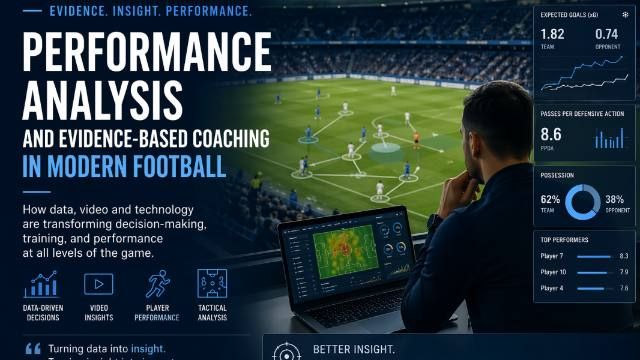
Performance analysis has become an integral part of the modern football environment, playing a pivotal role across all club levels of the sport (Mackenzie and Cushlon, 2012). Performance analysis is important for enhancing the coach's or individual's knowledge and informing decision-making (McGillick et al., 2024). Performance analysis contributes to evidence-based approaches that support decision-making, training planning, and tactical preparation within contemporary clubs (Carling et al., 2002). Due to the increasing competitive standards in football, football clubs have critically adopted data-driven and technology-supported approaches to improve the coaching process (Lyle and Cushion, 2017). Improvements in the quality and intensity of performance, and rapid technological developments in data gathering, video analysis, and player monitoring and tracking systems, have driven a shift in coaching processes. As a result, Abraham and Collins (2011) concluded that coaches can now systematically monitor performance, analyze trends, interpret outcomes, design training sessions, and evaluate performance within a well-developed framework aligned with evidence-based practice principles.
Evolution of Performance Analysis
Several studies discuss the origin of performance analysis in sports. Mackenzie and Cushlon (2012) found that performance analysis in sports originated in the United States of America, within American football and basketball, using coded notes in the 1960s. Racket sports such as tennis have used notational analysis to provide technical analysis on several actions, including serves, winners, and unforced errors (McGillick et al., 2024). The earliest notational system used for football was created by Charles Reep in 1950 (Pollard, 2010). Reep created a system to record the frequency of key performance indicators, such as goals, passing sequences, and other basic events in football matches, to identify and measure performance. In 1976, the time-motion analysis (TMA) method was used to observe performance and measure a player's movement patterns (Carling et al., 2008). Reep used Video Home System (VHS) tapes, TV broadcasts, and similar technologies to replay the game or to clip certain events.
The development of technology has enabled analysts and coaches to use more tools to achieve their targets. Over the last few years, the declining costs of video cameras and computers have enabled several companies to develop specialized software for various types of performance analysis (James, 2017). Several companies produce stadium cameras and design software that use artificial intelligence and automated tracking systems to track players’ physical and technical performance, providing feedback on the tactical side (Hands and Xanne, 2020). Hudl, a giant corporation in player performance analysis, produces flexible cameras for training, whereas stadium cameras can’t be used. The camera can record the game and send it to a specific platform, where analysts can use sophisticated software, such as Hudl Sportscode, to code it and provide in-depth insights into team and individual performance. Analysts can also identify and define their own Key Performance Indicators (KPIs) using these specialists software and utilize them automatically in each game.
Key performance indicator
Key performance indicators (KPIs) are essential to performance analysis because they are quantifiable metrics of team and player performance. Hughes and Bartlett (2002) argue that decades ago, analysts used KPIs to focus on the number of goals scored and conceded, as it was the only measure of the effectiveness of offensive and defensive actions in the competition. The ease of obtaining goal-scoring and goal-conceding data makes it readily available to analysts and coaches.
There are several limitations to the measures used to analyze whole-team performance, especially in their inability to capture the tactical complexity of football or to provide meaningful context for performance. Mackenzie and Cushion (2013) argued that, to provide a more comprehensive analysis, more complex performance indicators (PIs) must be developed; therefore, new, in-depth KPIs have emerged and are being used in elite and sub-elite clubs. The development of KPIs led to providing more complex data, such as expected goals (xG), expected threats (xT), passing network, and pressure intensity by measuring Passes per Defensive Actions (PPDA), which helped analysts to provide more effective analysis to coaches (Tenga et al., 2010; Collet, 2013; Lago-Peñas et al., 2011). Analysts benefit from the development of new indicators, providing coaches with more quantifiable performance data to help them identify the team's and opponent's strengths and weaknesses. Moreover, analysts can provide a development plan based on historical performance trends using a wide range of KPIs.
Rein and Memmert (2016) explain that KPIs are essential for providing evidence-based coaching, as during the observation stage, several KPIs can serve as objective evidence of team and player performance that coaches can use. For instance, when a team produces a high volume of shots or goal-scoring opportunities but generates low expected goals, as an analyst, I can examine the contextual factors to address tactical limitations, such as poor shot selection or decision-making in the final third (Mackenzie and Cushion, 2013). Another factor that supports evidence-based coaching is the integration of video analysis with KPIs interpretation as it helps coaches to build up a plan for training and games based on the outcome of the feedback from this integration and will not depend on the subjective observation only (Rein and Memmert, 2016). Key performance indicators are also used to assess team and player development over the season, providing coaches with insight into their plans and microcycle preparations (Hughes and Bartlett, 2002). Therefore, more KPI data needs to be provided to coaches, and the coaching staff needs a better understanding of the areas that require planning and improvement.
One of the most vital aspects for an analyst when using KPIs is to have a well-defined operational definition of the KPIs to ensure reliability, validity, and consistency in coding; this will make it easier to integrate KPIs into the coaching process (O’Donoghue, 2010; Rico and Bangsbo, 1996). I do agree with Cooper et al. (2007) that coaches and analysts must have a mutual agreement on what each metric means, such as “unsuccessful passes”, “defending wide areas”, “final third entries”, and “long passes”, to avoid any confusion or misinterpretation with coaching and feedback mechanisms. The agreement is achieved via a proportion-of-agreement approach (Cooper et al., 2007), where agreement is considered acceptable when it exceeds 90-95% (Hughes and Frank, 2004). Inter-rater reliability is used to evaluate reliability within elite clubs; however, in smaller clubs with limited resources, an intra-rater reliability method may be more suitable. The KPIs can be considered meaningful and aligned with tactical decisions when collaboration across departments, such as analysis, data science, recruitment, scouting, and players within an elite club, takes place (Wright et al., 2014). It provide and effective insight to support coaching decision-making. Coaches can use KPIs to assess players’ performance based on specific metrics, providing a benchmark and allowing the coaching staff to evaluate how well the team achieved its goals during the game against the game plan.
Although KPIs are broadly known as a vital component of performance analysis in football, specific contextual parameters influence their applicability and interpretation (Castellano et al., 2014; Vilar et al., 2013; Carling, 2011). There are many situational variables to consider in the analysis process, as PIs are context-dependent. These situational variables are opposition strength and quality, match location, and match status. KPIs may be misinterpreted if these contextual considerations are overlooked. Misinterpretation can lead to inaccurate insights and, consequently, negatively affect the coach’s decision-making and team performance; therefore, clear, well-defined operational definitions are crucial (Piggott et al., 2021). Additionally, Carling et al. (2014) argue that KPI outputs will be valuable if the coach and players receive them effectively and clearly. While Piggott et al. (2021) and Carling et al. (2011) explain the implications of not communicating the data, they do not provide the best method for communicating it.
I think this could be due to differences in how people perceive the information. This suggested that the effectiveness of the process relies on the coaching staff developing rapport with individuals and with each other to determine how each individual performs most effectively. Key Performance Indicators have proven successful across multiple disciplines and have been applied to different team sports. Expected Goals (xG) models are used in rugby to evaluate try-scoring and kicking opportunities (Sullivan et al., 2018); however, Oliver (2004) explains that possession-based metrics are used in basketball to guide shot selection and defensive shape. These examples demonstrate the effectiveness and importance of KPIs across different team sports and their coaching strategies, highlighting that performance analysis in football can be applied to other team sports and that KPIs are reliable.
Video Feedback and Telestrations
Several elite and sub-elite clubs create their own KPIs to provide the coaching staff with insights that help them make the right decisions and plan accordingly. However, to present KPI outcomes to coaching staff and players, analysts need to create video feedback for various analyses, such as individual, post-game, and pre-game. Video-based analysis provides an objective visual reference that helps players and coaching staff review match events, provide learning opportunities, and enhance decision-making (O’Donoghue, 2006). The core function of video-based analysis is to support individuals by providing information regarding performances to improve behavior and understanding (Court, 2004), so it is vital to provide better perspectives or angles. I argue that the presentation could illustrate the analysis using telestration. Telestrations play an essential role in elite clubs, especially in opposition analysis and in introducing important tactical information during pre-match sessions (Jones et al., 2020). Video feedback and telestration conclude the analysis that the analyst needs to present, as they are clear, can be replayed and paused, and provide objective evidence of performance (O’Donoghue and Mayes, 2013). Franks and Miller (1986) claim that coaches can recall as 30% of match events. Additionally, Laird and Waters (2008) show that recall of football-related events can be negatively affected by factors that influence those events, such as emotional responses and human limitations.
While earlier approaches to performance analysis focused on whole-match breakdowns and evaluations, the modern approach has shifted towards tagging and coding game events. The coding method allows coaching staff to identify key tactical principles and concepts and to use selected clips to improve players’ performance and provide learning opportunities (Franks and Miller, 1991). Telestrations, as an interactive tool that adds more insight to video-based analysis, are used alongside illustrations and animations to enhance analysis clips and add value to the feedback process by providing visual support that improves players' understanding and reduces ambiguity in coaching decision-making (Partington and Cushion, 2013). Brackenridge and Anderson (1985) and Lorains et al. (2013) discuss that video-based analysis with telestrations provides motivation, fosters self-sufficiency within the team, and enhances performance.
On the other hand, due to the complexity of human learning and development, the effectiveness of video-based analysis is not universal. There are different learning preferences and processes for both coaching staff and players, as the coaching staff may process the information most effectively; therefore, the feedback method must be designed to suit individual needs (Reeves and Roberts, 2013). In my experience, I confirm that providing a uniform feedback method may negatively impact the effectiveness of the analysis and reduce individuals' perception of it. This implication can be evident among less-experienced players, especially when telestrations or feedback are unclear or ambiguous (Hodges and Franks, 2008). As a result, coaches should consider this limitation when integrating video-based analysis with KPIs, as it reflects the increasingly interconnected and multifaceted nature of recent performance analysis processes.
Elite football clubs use video analysis differently from sub-elite clubs. Elite teams have access to a wide range of technologies and tools, such as sophisticated cameras with multiple angles or player-tracking capabilities, and dedicated analysis software, such as Hudl Sportscode and LiveTagPro, that help with event coding and performance KPI processing. On the other hand, sub-elite clubs often operate with limited technological resources, sometimes relying on basic recording devices such as mounted mobile phones, and, in some cases, are unable to conduct video analysis during matches. As a result, elite teams possess a clear advantage due to their access to higher-quality recording and coding technologies and larger coaching and analysis departments capable of managing the analytical workload.
With sub-elite and non-elite teams, they always look for affordable ways to analyze their performance, using free or low-cost options that often do not provide the same level of data or customization teams may need. However, all levels use video-based analysis because visual aids have been shown to help players learn and understand complex tactics (Vribik and Vribik, 2018). Therefore, combining key performance indicators (KPIs) with video analysis is a crucial part of how teams assess their performance, regardless of the level they're playing at. However, the level of sophistication in integrating technology into sports teams often depends on their budget and resources. For instance, elite clubs use wearable technology to monitor players’ biometric data and performance, with a live- data feed that sub-elite clubs cannot afford.
Wearable Technology
Since competitive football began, teams have been trying to measure their players' performance. Now, many teams, from the highest levels to the lower ones, use a range of tools, including specialized pads or even devices you wear on your feet — think Smart Shinpads or Playmaker Bootstrap. Researchers like Bradley et al. (2013) studied these tools, and Waldron et al. (2021) found that they can actually be quite beneficial to teams. These technologies enable real-time data collection, providing analysts with performance data to help coaching staff analyze KPIs and the physical and physiological conditions that affect players' performance. In addition, wearable technology is the key factor in the development of the coaching process; it enables coaches to assess their training strategy and performance conditions depending on whether this leads to goal-specific potential (Cummins et al., 2013). Analyzing Physical and Tactical Football of Players. Wearable devices measure vital signs and physical performance data, which the coaching staff and sports scientists can then use to determine whether particular training requires modification (Impellizzeri et al., 2019). McLean et al. (2016) elucidate such systems that allow coaches to track physiologic parameters that mitigate injury risk while also enhancing performance.
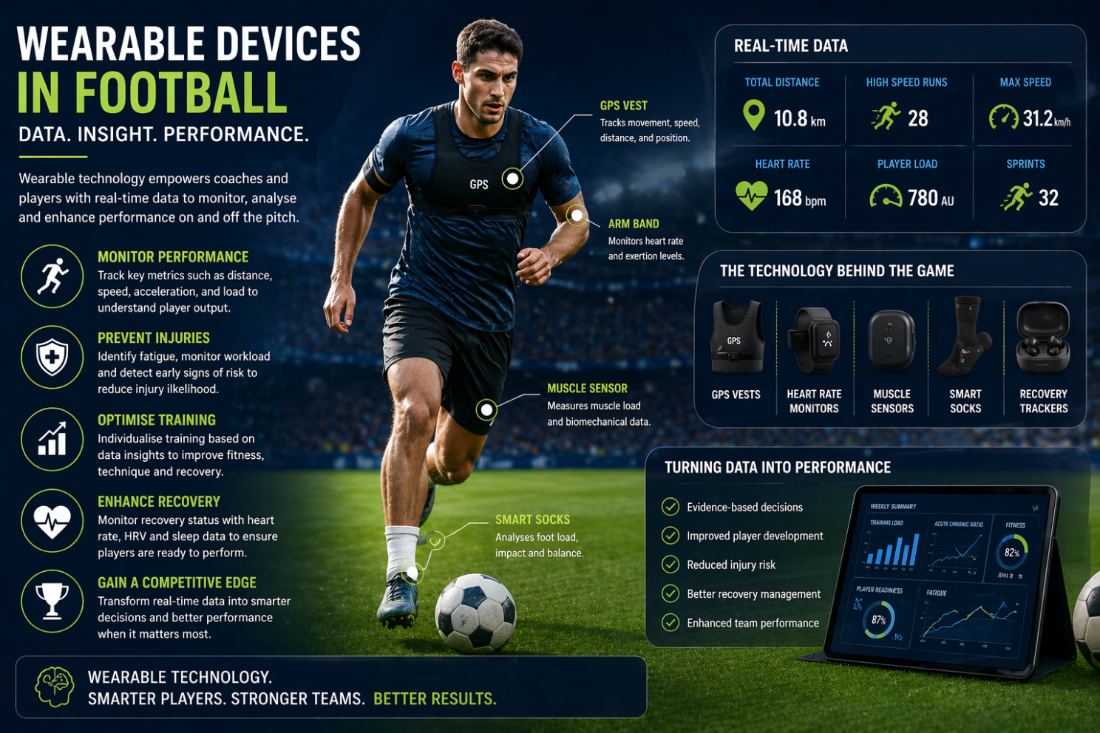
Despite the remarkable value of wearable technology in football, many limitations affect its effectiveness. One of these limitations is concern about the liability of wearable devices and the invasiveness of the data they collect (Ryall, 2012). Many studies have shown that incorrect device placement, misuse, or unsuitable environmental conditions may impact the reliability of data output (Cummins et al., 2013). Although concerns about inaccuracy are rare, the intrusive nature of wearable technology has prompted a search for alternative monitoring methods. Consequently, alternative monitoring systems have historically been promoted to overcome these issues. A time-motion analysis that aims to provide motion-tracking data without requiring players to wear devices (Ali and Farrally, 1991). Nevertheless, this approach shows several limitations as explained by Dogramaci and Watsford (2006). The time-motion analysis relies on redefining velocity thresholds in the absence of contextual data and requires human intervention during analysis, introducing human error risk and compromising the objectivity of the data collection.
Coaching practices in football have been significantly reshaped by the introduction of performance analysis, which contributes to an evidence-based approach throughout the coaching cycle, including performance, observation, analysis, interpretation, planning, and preparation (Carling et al., 2005). Coaching staff can use advanced KPIs that provide objective benchmarks for evaluating performance, planning training, and delivering targeted feedback to improve both team and player performance. Video feedback helps coaches deliver a clear representation of tactical behavior and objectively review match events, providing deeper insight into performance trends. This deeper insight is achieved by combining KPIs, video feedback, and wearable device data. Wearable devices inform coaches’ decisions about workload management, tactical strategies, recovery plans, and physical training planning. I believe that integrating KPIs, video-based analysis, and wearable technologies enables coaching staff to adopt a more holistic approach to decision-making, as the data from these three trends enhances both team and player performance. However, the use of these developments differs between elite and sub-elite environments due to variation in financial capabilities, technological infrastructure, and human resources. Despite these challenges, the core principles of performance analysis remain transferable and can be implemented across different levels in sport. Although the implications coaches and analysts faced regarding reliability and validity, the output of performance analysis must be converted into meaningful coaching interventions.
Conclusion
Performance analysis has firmly established itself as a central pillar of modern football, driving the transition towards structured, evidence-based coaching practices. The integration of advanced KPIs, video-based feedback, and wearable technologies has enhanced the objectivity and depth of performance evaluation, enabling coaches to move beyond intuition towards informed decision-making. However, the value of performance analysis does not lie in data accumulation alone, but in its accurate interpretation and practical application within the coaching process. The contextual dependence of KPIs, alongside challenges related to reliability, validity, and communication, highlights that without clear operational definitions and strong coach–analyst collaboration, even sophisticated analytical systems risk being ineffective. Furthermore, while technological disparities exist between elite and sub-elite environments, the core principles of performance analysis remain transferable, with effectiveness ultimately determined by how insights are translated into actionable coaching interventions. Therefore, performance analysis should be understood not merely as a tool for observation, but as an applied decision-support system, where the successful integration of data, video, and context is essential to achieving meaningful impact on performance outcomes.
References
Abraham, A. & Collins, D. (2011) ‘Effective skill development: How should athletes’ skills be developed?’, Coaching and Sport Science Review, 53(19), pp.10–12.
Ali, A.R.A.Z. & Farrally, M. (1991) ‘A computer-video aided time motion analysis technique for match analysis’, The Journal of Sports Medicine and Physical Fitness, 31(1), pp.82–88.
Brackenridge, C.H. & Anderson, G.J.K. (1985) Match analysis. Leeds: National Coaching Foundation / Whiteline Press.
Bradley, P.S. et al. (2013) ‘Match performance and physical capacity of players in the top three competitive standards of English professional soccer’, Human Movement Science, 32(4), pp.808–821.
Carling, C. (2011) ‘Influence of opposition team formation on physical and skill-related performance in a professional soccer team’, European Journal of Sports Science, 11(3), pp.155–164.
Carling, C., Wright, C., Nelson, L. & Bradley, P.S. (2014) ‘Commentary: The role of performance analysis in elite football coaching’, Journal of Sports Sciences, 32(2), pp.175–185.
Castellano, J., Alvarez-Pastor, D. & Bradley, P.S. (2014) ‘Evaluation of research using computerised tracking systems in football: The need for new approaches’, International Journal of Performance Analysis in Sport, 14(1), pp.1–13.
Cooper, S.M., Hughes, M., O’Donoghue, P. & Nevill, M.A. (2007) ‘A simple statistical method for assessing the reliability of data entered into sport performance analysis systems’, International Journal of Performance Analysis in Sport, 7(1), pp.87–109.
Court, M. (2004) ‘Perceptions of performance analysis’, Insight, Winter, pp.8–11.
Cummins, C., Orr, R., O’Connor, H. & West, C. (2013) ‘Global positioning systems (GPS) and microtechnology sensors in team sports: A systematic review’, Sports Medicine, 43(10), pp.1025–1042.
Dogramaci, N.S. & Watsford, L.M. (2006) ‘A comparison of two different methods for time-motion analysis in team sports’, International Journal of Performance Analysis in Sport, 6(1), pp.73–83.
Franks, I.M. & Miller, G. (1991) ‘Training coaches to observe and remember’, Journal of Sports Sciences, 9(3), pp.285–297.
Gilbert, W. & Trudel, P. (2004) ‘Analysis of coaching science research published from 1970–2001’, Research Quarterly for Exercise and Sport, 75(4), pp.388–399.
Hodges, N.J. & Franks, I.M. (2008) Learning a Motor Skill: Implications for Coaching Practice. London: Routledge.
Hughes, M. & Bartlett, R. (2002) ‘The use of performance indicators in performance analysis’, Journal of Sports Sciences, 20(10), pp.739–754.
Hughes, M. & Franks, I.M. (eds.) (2004) Notational analysis of sport: Systems for better coaching and performance in sport. London: Psychology Press.
James, N. (2006) 'Notational analysis in soccer: past, present and future.,' International Journal of Performance Analysis in Sport, 6(2), pp. 67–81. https://doi.org/10.1080/24748668.2006.11868373.
Laird, P. & Waters, L. (2008) ‘Eyewitness recollection of sports coaches’, International Journal of Performance Analysis in Sport, 8(1), pp.76–84.
Lorains, M., Ball, K. & MacMahon, C. (2013) ‘Performance analysis for decision making in team sports’, International Journal of Performance Analysis in Sport, 13(1), pp.110–119.
Lutz, J. et al. (2019) 'Wearables for Integrative performance and tactic analyses: opportunities, challenges, and future directions,' International Journal of Environmental Research and Public Health, 17(1), p. 59. https://doi.org/10.3390/ijerph17010059.
Lyle, J. & Cushion, C. (2017) Sports Coaching Concepts: A Framework for Coaches’ Behaviour. 2nd edn. London: Routledge.
Mackenzie, R. & Cushion, C. (2013) ‘Performance analysis in football: A critical review and implications for future research’, Journal of Sports Sciences, 31(6), pp.639–676.
Mangan, S. et al. (2021) 'A tactical periodisation model for Gaelic football,' International Journal of Sports Science & Coaching, 17(1), pp. 208–219. https://doi.org/10.1177/17479541211016269.
McGarry, T. (2009) ‘Applied and theoretical perspectives of performance analysis in sport: Scientific issues and challenges’, International Journal of Performance Analysis in Sport, 9(1), pp.128–140.
McGillick, C. et al. (2024) 'Performance analysis in sport and soccer: Past, present and future – narrative review,' Journal of Sports Research, 11(1), pp. 19–41. https://doi.org/10.18488/90.v11i1.3915.
McLean, S. et al. (2016) ‘Reliability and validity of GPS for athlete monitoring’, Journal of Strength and Conditioning Research, 30(11), pp.3250–3256.
Memmert, D. and Rein, R. (2018) 'Match analysis, Big Data and tactics: current trends in elite soccer,' German Journal of Sports Medicine, 2018(03), pp. 65–72. https://doi.org/10.5960/dzsm.2018.322.
O’Donoghue, P. (2010) Research Methods for Sports Performance Analysis. London: Routledge.
O’Donoghue, P. & Mayes, A. (2013) ‘Performance analysis, feedback and communication in coaching’, in McGarry, T., O’Donoghue, P. & Sampaio, J. (eds.) Routledge Handbook of Sports Performance Analysis. London: Routledge, pp.155–165.
Partington, M. & Cushion, C. (2013) ‘An investigation of the practice activities and coaching behaviours of professional top-level youth soccer coaches’, Scandinavian Journal of Medicine and Science in Sports, 23(3), pp.374–382.
Piggott, B., Müller, S., Chivers, P. & Hoyne, G. (2021) ‘Defining key performance indicators in sport: A systematic review’, PLOS ONE, 16(3), pp.1–25.
Reeves, M.J. & Roberts, S.J. (2013) ‘Perceptions of performance analysis in elite youth football’, International Journal of Performance Analysis in Sport, 13(1), pp.200–211.
Rein, R. & Memmert, D. (2016) ‘Big data and tactical analysis in elite football: Future challenges and opportunities for sports science’, SpringerPlus, 5(1), pp.1410–1423.
Rico, J. & Bangsbo, J. (1996) ‘Coding system to evaluate actions with the ball during a soccer match’, in Notational Analysis of Sport, pp.85–90.
Ryall, E. (2012) ‘Are there any good arguments against goal-line technology?’, Sport, Ethics and Philosophy, 6(4), pp.439–450.
Sullivan, C. et al. (2018) ‘Modelling rugby union performance using expected points’, International Journal of Sports Science & Coaching, 13(6), pp.974–984.
Taylor, J.B. et al. (2008) 'The influence of match location, quality of opposition, and match status on technical performance in professional association football,' Journal of Sports Sciences, 26(9), pp. 885–895. https://doi.org/10.1080/02640410701836887.
Vilar, L., Araújo, D., Davids, K. & Bar-Yam, Y. (2013) ‘Science of winning: Pattern-forming dynamics in association football’, Journal of Systems Science and Complexity, 26(1), pp.73–84.
Vribik, I. & Vribik, A. (2018) ‘Video demonstration as a way of teaching in education’, Croatian Journal of Education, 19(2), pp.201–213.
Waldron, M., Harding, J., Barrett, S. & Gray, A. (2021) ‘A new foot-mounted inertial measurement system in soccer: Reliability and comparison to global positioning systems for velocity measurements’, Journal of Human Kinetics, 77(1), pp.37–50.
Wright, C. et al. (2016) 'Elite football player engagement with performance analysis,' International Journal of Performance Analysis in Sport, 16(3), pp. 1007–1032. https://doi.org/10.1080/24748668.2016.11868945.
Wright, C., Carling, C. & Collins, D. (2014) ‘The wider context of performance analysis and its application in the football coaching process’, International Journal of Performance Analysis in Sport, 14(3), pp.709–733.