Performance-based sports – and football in particular – are ultimately judged on results and performances to win games. The success of any elite club, however, cannot be measured solely by what happens on the field for its players. Instead, it has become ever more reliant on a sophisticated and often invisible network of backroom staff whose contributions to performance, while seldom acknowledged by the wider public, are crucial. Modern elite football clubs operate as multidisciplinary performance organizations, and the effectiveness of specialist staff is largely mediated by their ability to interface, integrate, and align their work with established performance goals (Stewart et al., 2024). Therefore, to achieve the best team results and the club's sporting goals, these individuals need to work as one. In this multidisciplinary framework, the performance analyst is one of the central specialist functions. Although performance analysis can, in theory, exist as a separate entity within a club's organizational structure, its real value at the elite level comes when an analyst's work transcends departmental boundaries. This essay argues that analysts would engage with and shape the work of coaches, sport scientists, and scouting staff to create a holistic approach towards the performance pathway.
Analyst and Coach Relationship
The coach is the most crucial figure in football when it comes to decision-making. The head coach is responsible for organizing tactics, developing players, and managing match preparation and performance (Cushion et al., 2006). These are the things they use to make judgments at all levels; nevertheless, coaches at all levels of top sports may now use performance analysis (Wright et al., 2012). The reason why coaches could utilize performance analysis in their workflow is that modern football coaching has become more tactical, and the way a team is set up, how they press, how well they transition, and how well they manage space all affect the outcome of a match (Tenga et al., 2010). The increase in tactical demand and easier access to information has led to a rise in the usage of performance analysis in football. This trend has developed only over the past thirty years and is now being used at lower levels as well. Lyle and Cushion (2017) argue that, in the modern football environment, performance data from analysts now has a significant impact on coaching decisions.
Analysts support coaches in various ways, including helping with decision-making, generating feedback, providing learning opportunities, and ultimately reducing the coach’s cognitive load. The most basic way performance analysts support coaches is by better informing tactical decisions with game data (Rein and Memmert, 2016). This data is helpful since it gives coaches more insight into their decision-making, making those decisions themselves statistically more likely to produce the desired result. Most importantly, analysts should ensure that they can place statistics in the context of the models used to describe the game, avoiding numbers out of context in terms of tactical meaning (Rein and Memmert, 2016). Improper information or data will also have negative consequences, as it will leave coaches with inaccurate data and is likely to lead to false conclusions. It can also directly influence how the coach provides personalized development to their team. Moreover, according to Groom and Cushion (2024), video-based feedback is used to develop tactical understanding and decision-making in footballers. When coaches connect video analysis to coaching goals, they may provide better feedback to individuals or teams. Williams and Hodges (2005) discuss that research on observational learning suggests that visual feedback improves perception–action coupling, further supporting the benefits of this method. When analysts make video analysis based on the concepts that the coach requires, this directly helps players learn.
Elite coaches have significant time constraints and decision-making uncertainties (Jones and Wallace, 2005), necessitating that analysts prioritize information pertinent to successful match preparation and adaptations to evolving game circumstances. Analysts can filter data sets into small dashboards and visualizations to make it easier for the coach to make decisions in a high-pressure setting. Conversely, coaches can support analysts by clarifying their work outputs and fostering an overall data-informed culture within the team. Coaches are key contributors to a team’s culture, as research on high-performance environments indicates that shared mental models (Eccles and Tenenbaum, 2004) among members are paramount. This practice promotes a more productive process between analyst and athlete, where data and video footage are supported, encouraging players to contextualize analytical feedback. To achieve this, the coaches need to set clear metrics and expectations for analysts so they can deliver valuable work for the team. Though such a data-led culture is necessary to promote, coaches and analysts have to make sure there’s not an overreliance on data, as this can backfire.
In their study, Bateman and Jones (2019) examined the relationships between elite professional football analysts and coaches and concluded that for successful practice, analysts must understand a coach’s needs and requirements. They examined the extent to which it is important for coaches to translate and use analytical outputs when context and tactical intent are emphasized. By being clear about their needs and maintaining a positive relationship with the analysts, coaches can better understand the context of the data they provide, helping them move closer to achieving specific outcomes. It is crucial that the analyst is in place to provide direct support to the coaches, but it’s also imperative that the coaches recognize the value of this position and do their part to ensure a successful process.
Analyst and Sport Scientist’s Relationship
Sport scientists and performance analysts share common concepts in elite sport situations as they both utilize data to assess and enhance performance. Sport scientists often assess physical and physiological measurements to track training load and support evidence-based decisions around athlete preparation (Bourdon et al., 2017). However, these physical outputs typically require further interpretation to be significant in the context of football play. This is where performance analysts add value, as they help interpret numerical data and translate it into tactical information that complements the work of sport scientists. For example, the data gathered using Global Positioning System (GPS) technology can help to determine physical outputs such as sprint distance, high-speed running, accelerations, and overall distance covered. However, these measurements are mostly descriptive and do not explain why such demands arose during play. As Buchheit and Simpson (2017) point out, physical data needs to be understood in the context of the tactical situation; otherwise, conclusions may be false or incomplete. The analyst’s job is to provide this tactical explanation, frequently accompanied by video evidence. A high sprint count may indicate an aggressive pressing strategy, and less high-speed running may represent a compact defensive block rather than a lack of effort or physical capabilities. According to ecological dynamics, performance is a product of the interaction between the performer, the task, and the environment (Davids et al., 2008). Clubs can get a more holistic knowledge of performance by merging physical and tactical information.
Performance data should be used effectively by all departments in the club and should be worked on together. Analysts can associate the physical load of training sessions with the tactical objectives of the coaching staff, such as repetitive offensive or defensive patterns, pressing triggers, and periods of transition. This contextual knowledge can then be used by sport scientists to create training programs that better reflect the real challenges of competition (Malone et al., 2015). Additionally, sport scientists play a vital role in reducing the risk of injury by appropriately managing load. Training should, therefore, be organized so as to combine tactical objectives with physical preparation and player well-being. Gabbett (2016) argues that quick increases in training load may increase the chance of injury. However, sometimes repeated high-intensity movements might be a tactical necessity, such as in counter-attacking play. Once these demands are well recognized, the sports science department can develop more appropriate preventative tactics without impacting the tactical character of the team.
The sports science department is primarily responsible for collecting physical performance data, while the performance analysts do an essential job of analyzing this data around the tactical context in matches. Reliable procedures are important because analysts need confidence in the accuracy of the metrics they are looking at. For instance, assessing the validity of GPS ensures that these physical outputs are interpreted and applied correctly (Cummins et al., 2013). This type of interdisciplinary collaboration ensures that clubs can use performance data more rigorously and that training design and match analysis are of a higher quality. Analysts provide tactical insight; sport scientists, however, help analysts grasp some essential physiological principles. This might include power systems and fatigue processes, as well as rehabilitation timelines. This is important because it enables analysts to interpret physical and load-related data in ways that better align with the needs of football performance. Halson (2014) suggests that this alignment may be the case, as a better understanding of responses associated with fatigue recovery and physiology has been shown to improve analysts' interpretation of training and performance measurements. As a result, the knowledge transfer between the departments provides a more comprehensive analysis of performance as it relates to physiological data alongside tactical and physical requirements for the game.
Sport scientists can also improve multidisciplinary practice by supporting departments in building integrated data systems. The targeted performance outputs can be enhanced in elite athletic situations through shared dashboards and data-fusion platforms that couple events with physiological data (Wang et al., 2025). Dashboards and platforms allow analysts and sport scientists to access and process crucial information more efficiently; therefore, the two departments don't have to communicate directly over the phone all the time. Since creating such dashboards takes time, decisions can be made more quickly and based on factual data. Nevertheless, data platforms can also do the opposite if they promote a one-way stream of information from one department to another instead of an active dialogue. As a result, while analysts do not always need to be embedded in the sports science department, it is still necessary for them to have transparent lines of communication by which tactical interpretation and context regarding shared data may be offered. This is especially important because physical metrics are easily misinterpreted when viewed without tactical context. This issue is compounded by the fact that both analysts and sports scientists work in a time-pressured environment that makes it one of the main barriers to overcoming this problem.
In conclusion, it is essential for performance analysts and sport scientists to closely work together in order to successfully integrate tactical and physiological data. This collaboration, if done well, can improve training design, support injury-risk management, and deepen the understanding of on-field performance in elite football contexts.
Analyst and Scout’s Relationship
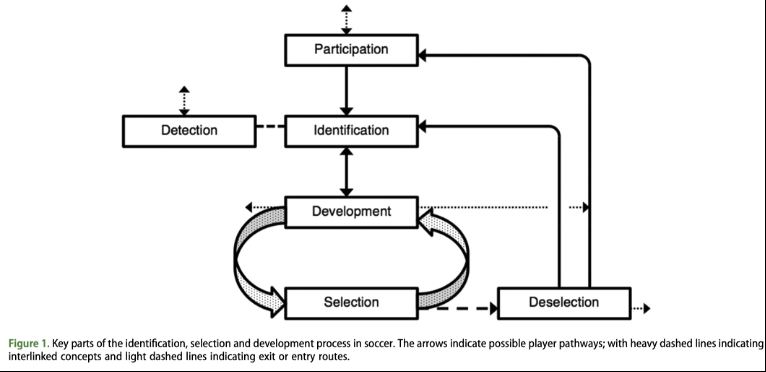
The role of talent identification in the professional football industry is increasingly viewed as a joint responsibility for individuals involved in performance analysis and scouting, not purely based on each discipline. Williams et al. (2020) provide a foundational framework for conceptualizing this relationship, presenting talent identification as an ongoing, dynamic, multidisciplinary, and longitudinal process. Williams et al.'s (2020) process model (Figure 1) identifies the course a player travels along—detection, identification, development, selection, and deselection—and shows this as a pathway that can be entered or exited at any point. This disposition frames scouting and analysis as not distinct functions, but rather phases of one continuous process wherein a player might be acquired, developed, drafted, or undrafted multiple times throughout their career.
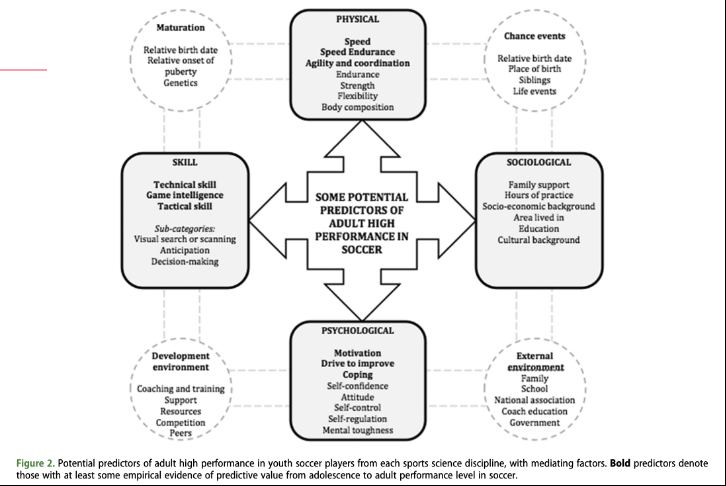
Through this process, Williams et al. (2020) identified four types of predictors that many researchers feel underpin adult high performance in football: physical, psychological, sociological, and skill-based factors (Figure 2). Performance analysis feeds most directly into the skill predictor and also into the development environment mediator. While scouts have always made observational judgments about players' technical and tactical skills, analysts can augment this judgment with video analysis, performance tracking, and statistical benchmarking. In practice, this means analysts can put numbers on elements of technical ability, game intelligence, and tactical understanding—for instance, a player's passing accuracy, decision-making under pressure, ball control, and visual scanning behavior—that would otherwise be left to the scout's discretion. Support the development environment by assessing training and competition load and exposure; analyze the market through monitoring training loads alongside competitive performance against peers; and advise on resources required to ensure delivery of an optimal talent identification/recruitment process.
A central argument for embedding analysis within scouting is cost and time efficiency. Traditional in-person scouting requires travel, and a scout may arrive to find a target player injured, unselected for the match, or simply having an off day—a considerable sunk cost for a single data point (Williams et al., 2020). Even basic analytical inputs can mitigate this risk: platforms such as Wyscout supply baseline biographical information (age, height, preferred foot), while platforms such as Hudl or Veo allow clips to be shared between individuals and clubs, helping recruitment staff decide which live matches are worth prioritizing for in-person scouting. Williams et al. (2020) elaborate that this approach has given rise to video scouting as a distinct role, removing the need for travel and offering a more cost- and time-efficient first pass over a wider pool of players; only once players have been shortlisted through video does in-person scouting become necessary, allowing it to be applied more selectively and precisely.
Statistical methods extend this further. For example, analysts can use principal component analysis to cluster players into pockets of stylistic similarity, which can aid clubs in identifying the right sort of player needed for a specific playing style or tactical requirement. These are not necessarily a one-to-one measure of competency but can be especially useful when attempting to evaluate players in leagues where scouting networks or experience is lacking (Williams et al., 2020). This relative resourcing of each method further explains why the blended approach works efficiently, as an analyst can screen an effectively unlimited number of matches through data using only about two hours; video review of four matches (including report writing) takes a similarly long period, around two hours; and traditional scouting of a single match once travel is coded up and report written typically costs around four hours. Data thus does the first part of the hard work in applying club-specific filters to players; video brings that data contextualization and facilitates side-by-side visual comparison between different players; and in-person scouting effectively provides an even more intensive view. According to Williams et al. (2020), data analysis, video analysis, and conventional scouting are complementary or dependent, as they do not have to be mutually exclusive methods of influencing recruitment practices; rather, an integrated approach is required from all three, rather than relying on one in isolation. This interaction allows analysts to be embedded in recruitment departments as recruitment analysts, and it explains the hybrid role that has developed of a technical or video scout, with skills from both areas carrying weight, while traditional, on-range scouts are still at an entirely different table on the organizational chart.
The aspect of the relationship between analysts and scouts that is based on the scout, however, is a type of knowledge that is much more complex to codify than any analytical output. According to Nash and Collins (2006), scouting is based not on a simple search from a set store of information or potential hypotheses but rather on a complex interaction of knowledge and memory honed through extensive experience and contemplation. Christensen's (2009) influential study of the socially constructed invisible 'eye for talent' identified that scouts' judgments are frequently drawn from visual experience and intuition, which several scouts describe using personal terms of reference such as 'gut feeling,' something perceived with the 'mind's eye,' or assessed based on one's inner self. Similarly, scouts are trained to value soft skills and an intuitive, gut feeling for talent (Franssen and Kuipers, 2013), making scouting fundamentally a 'gut business' (Darr and Mears, 2017). Lund and Soderstrom (2017) further contend that this acumen is governed by prior scout identifications and personal articulations of the requirements of professional football and how those characteristics of players are appropriate for one context while irrelevant in another. According to Christensen (2009), scouts seem to have authentic skills that inform this kind of intuitive judgment, but more research is needed to specify these skills and explore how they can be developed. The combination of these bodies of work indicates a complementary model of division of professions: scouts provide experience-based, intuitive, context-sensitive judgment that is less conducive to formalization as it relates to human insight, and analysts provide evidence that is objective, scalable, and reproducible in nature.
Conclusion
To conclude, performance analysis in modern elite football should be understood not only as a technical task of collecting data or producing video materials but also as an interdisciplinary activity that links knowledge from multiple performance domains. The evidence discussed in this essay suggests that the analyst’s real worth lies in their ability to transform complex information into contextually relevant understanding for coaches, sport scientists, and scouts. However, this value does not appear automatically. Analytical work becomes effective only when it is supported by clear communication channels, shared tactical comprehension, and a club culture that recognizes both the potential and the limitations of data. The analyst–coach relationship remains essential, yet tactical data must correspond to coaching objectives rather than stand as detached proof. Similarly, cooperation with sport scientists shows that physical data need tactical interpretation to inform training planning, load control, and injury prevention. Data filtering, benchmarking, and video materials can assist analysts in improving recruitment processes, though they cannot substitute the experiential judgment, contextual sensitivity, and intuition of scouts. The performance analyst should therefore be regarded as a linking professional within the club’s multidisciplinary structure. Their task is not to replace expert judgment but to reinforce it through evidence, context, and cooperation. Ultimately, performance analysis concerns less the abundance of data and more the way that data is interpreted, communicated, and embedded within collective decision-making across the football organization.
References
Bampouras, M.T., Cronin, C. and Miller, K.P. (2012) 'Performance analytic processes in elite sport practice: An exploratory investigation of the perspectives of a sport scientist, coach and athlete,' International Journal of Performance Analysis in Sport, 12(2), pp. 468–483. https://doi.org/10.1080/24748668.2012.11868611.
Bateman, M. and Jones, G., (2019) Strategies for maintaining the coach–analyst relationship within professional football utilizing the COMPASS model: The performance analyst’s perspective. Frontiers in Psychology, 10, Article 2064.
Bergkamp, T.L.G., Frencken, W.G.P, Niessen, A.S.M, Meijet R.R., and Hartigh, R. J. R. D. (2021) 'How soccer scouts identify talented players,' European Journal of Sport Science, 22(7), pp. 994–1004. https://doi.org/10.1080/17461391.2021.1916081.
Bourdon, P.C. et al. (2017) 'Monitoring Athlete Training Loads: Consensus Statement,' International Journal of Sports Physiology and Performance, 12(s2), pp. S2-161. https://doi.org/10.1123/ijspp.2017-0208.
Buchheit, M. and Simpson, B.M., (2017) Player-tracking technology: Half-full or half-empty glass? International Journal of Sports Physiology and Performance, 12(S2), pp.35-41.
Christensen, M.K. (2009) “An Eye for Talent”: Talent identification and the “Practical Sense” of Top-Level Soccer Coaches,' Sociology of Sport Journal, 26(3), pp. 365–382. https://doi.org/10.1123/ssj.26.3.365.
Cummins, C., Orr, R., O’Connor, H. and West, C., (2013) Global positioning systems (GPS) and microtechnology sensors in team sports: A systematic review. Sports Medicine, 43(10), pp.1025-1042.
Darr, A. and Mears, A. (2017) 'Locating local knowledge in global networks: Scouting in fashion and football,' Poetics, 62, pp. 1–14. https://doi.org/10.1016/j.poetic.2017.03.001.
Davids, K., Araújo, D., Shuttleworth, R. and Button, C., (2008) Ecological task analysis: A constraints-led approach to understanding skill acquisition in sport. In: D. Farrow, J. Baker and C. MacMahon, eds. Developing sport expertise: Researchers and coaches put theory into practice. London: Routledge.
Eccles, D.W. and Tenenbaum, G., (2004) Why an expert team is more than a team of experts: A theoretical model and data on shared cognition in sport. Journal of Sport & Exercise Psychology, 26(4), pp.542-560.
Gabbett, T.J., (2016) The training-injury prevention paradox: Should athletes be training smarter and harder? British Journal of Sports Medicine, 50(5), pp.273-280.
Ghar, S., Patil, S. and Arunachalam, V. (2021) 'Data Driven football scouting assistance with simulated player performance extrapolation,' 2021 20th IEEE International Conference on Machine Learning and Applications (ICMLA), pp. 1160–1167. https://doi.org/10.1109/icmla52953.2021.00189.
Groom, R. and Cushion, C., (2004) Coaches’ interventions in elite youth soccer: A commentary on the use of video-based feedback. Journal of Sports Sciences, 22(5), pp.483-484.
Halson, S.L., (2014) Monitoring training load to understand fatigue in athletes. Sports Medicine, 44(2), pp.139-147.
Jones, R.L. and Wallace, M., (2005) Another bad day at the training ground: Coping with ambiguity in the coaching context. Sport, Education and Society, 10(1), pp.119-134.
Klein, C., Luig, P., Henke, T., Blocj, H., and Platen, P. (2020) 'Nine typical injury patterns in German professional male football (soccer): a systematic visual video analysis of 345 match injuries,' British Journal of Sports Medicine, 55(7), pp. 390–396. https://doi.org/10.1136/bjsports-2019-101344.
Lawlor, C., Rookwood, J. and Wright, C. (2021) Player scouting and recruitment in English men’s professional football: opportunities for research. Journal of Qualitative Research in Sports Studies, 15, 1, 57-76.
Lund, S. and Söderström, T. (2017) 'To see or not to see: Talent identification in the Swedish Football Association,' Sociology of Sport Journal, 34(3), pp. 248–258. https://doi.org/10.1123/ssj.2016-0144.
Lyle, J. and Cushion, C., (2017) Sport coaching concepts: A framework for coaching practice. 2nd ed. London: Routledge.
Malone, S., Owen, A., Mendes, B., Hughes, B., Collins, K. and Gabbett, T.J., (2015) High-speed running and sprinting as an injury risk factor in soccer: Can well-developed physical qualities reduce the risk? Journal of Science and Medicine in Sport, 18(1), pp.109-114.
Mann, D.L., Fortin-Guichard, D. and Müller, D. (2025) 'A framework of cognitive biases that might influence talent identification in sport,' International Review of Sport and Exercise Psychology, pp. 1–28. https://doi.org/10.1080/1750984x.2025.2556393.
Nash, C. and Collins, D. (2006) 'Tacit knowledge in expert coaching: science or art?,' Quest, 58(4), pp. 465–477. https://doi.org/10.1080/00336297.2006.10491894.
Nosek, P., Brownlee, T. E., Drust, B., and Andrew, M. (2020) 'Feedback of GPS training data within professional English soccer: a comparison of decision making and perceptions between coaches, players and performance staff,' Science and Medicine in Football, 5(1), pp. 35–47. https://doi.org/10.1080/24733938.2020.1770320.
Owen, R., Seamus, H., Smith, B., and Jones, B. (2024) 'A comparison of in-person versus video-recorded player assessment by English Category One Football Academy Scouts,' STOR (Dundalk Institute of Technology) [Preprint].
Parnell, D., Bond, A. J., Widdop, P., Groom, R., and Cockayne, D. (2021) 'Recruitment in elite football: a network approach,' European Sport Management Quarterly, 23(5), pp. 1370–1386. https://doi.org/10.1080/16184742.2021.2011942.
Pons, E. et al. (2019) 'A comparison of a GPS device and a multi-camera video technology during official soccer matches: Agreement between systems,' PLoS ONE, 14(8), p. e0220729. https://doi.org/10.1371/journal.pone.0220729.
Raya-Castellano, E.P. and Uriondo, L.F. (2015) 'A review of the multidisciplinary approach to develop elite players at professional football academies: Applying science to a professional context,' International Journal of Performance Analysis in Sport, 15(1), pp. 1–19. https://doi.org/10.1080/24748668.2015.11868773.
Rein, R. and Memmert, D., (2016) Big data and tactical analysis in elite soccer: Future challenges and opportunities for sports science. SpringerPlus, 5, Article 1410.
Stewart, P., Fletcher, D., Arnold, R., and McEwan, D. (2024) 'Performance support team effectiveness in elite sport: a narrative review,' International Review of Sport and Exercise Psychology, 19(1), pp. 126–149. https://doi.org/10.1080/1750984x.2024.2411215.
Tenga, A., Holme, I., Ronglan, L.T. andBahr, R., (2010) Effect of playing tactics on achieving score-box possessions in a random series of team possessions from Norwegian professional soccer matches. Journal of Sports Sciences, 28(3), pp.245-255. https://doi.org/10.1080/02640410903502766
Wang, Z., Xia, X. and Chen, Q., (2025) Multi-level data fusion enables collaborative dynamics analysis in team sports using wearable sensor networks. Scientific Reports, 15, Article 28210.
Williams, A.M. and Hodges, N.J., (2005) Practice, instruction and skill acquisition in soccer: Challenging tradition. Journal of Sports Sciences, 23(6), pp.637-650.
Williams, A.M., Ford, P.R. and Drust, B. (2020) 'Talent identification and development in soccer since the millennium,' Journal of Sports Sciences, 38(11–12), pp. 1199–1210. https://doi.org/10.1080/02640414.2020.1766647.
Wright, C., Carling, C., Lawlor, C., and Collins, D. (2016) 'Elite football player engagement with performance analysis,' International Journal of Performance Analysis in Sport, 16(3), pp. 1007–1032. https://doi.org/10.1080/24748668.2016.11868945.
Wright, C., Atkins, S., Jones, B., Todd, J. and O’Donoghue, P., (2012) An analysis of elite coaches’ engagement with performance analysis services (match, notational and technique analysis). International Journal of Performance Analysis in Sport, 12(2), pp.436-451.